
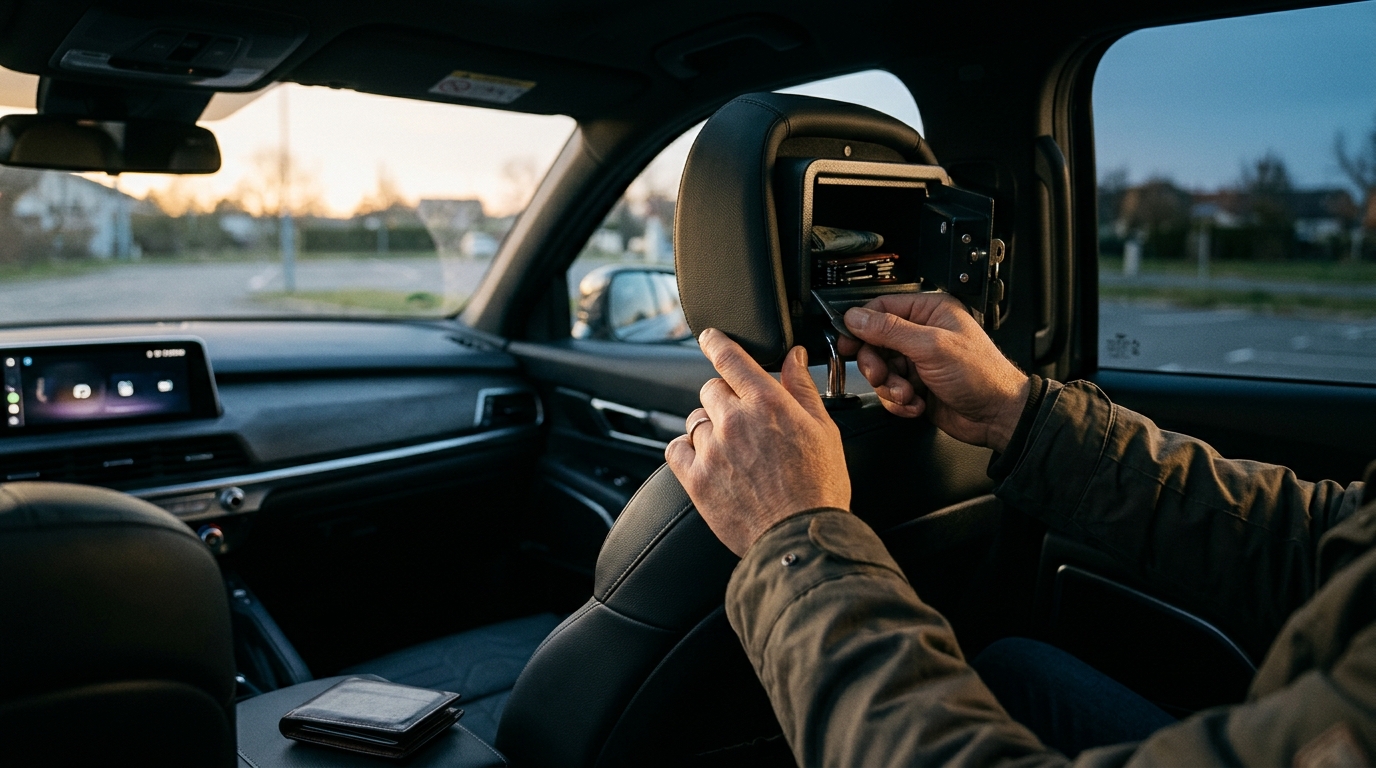
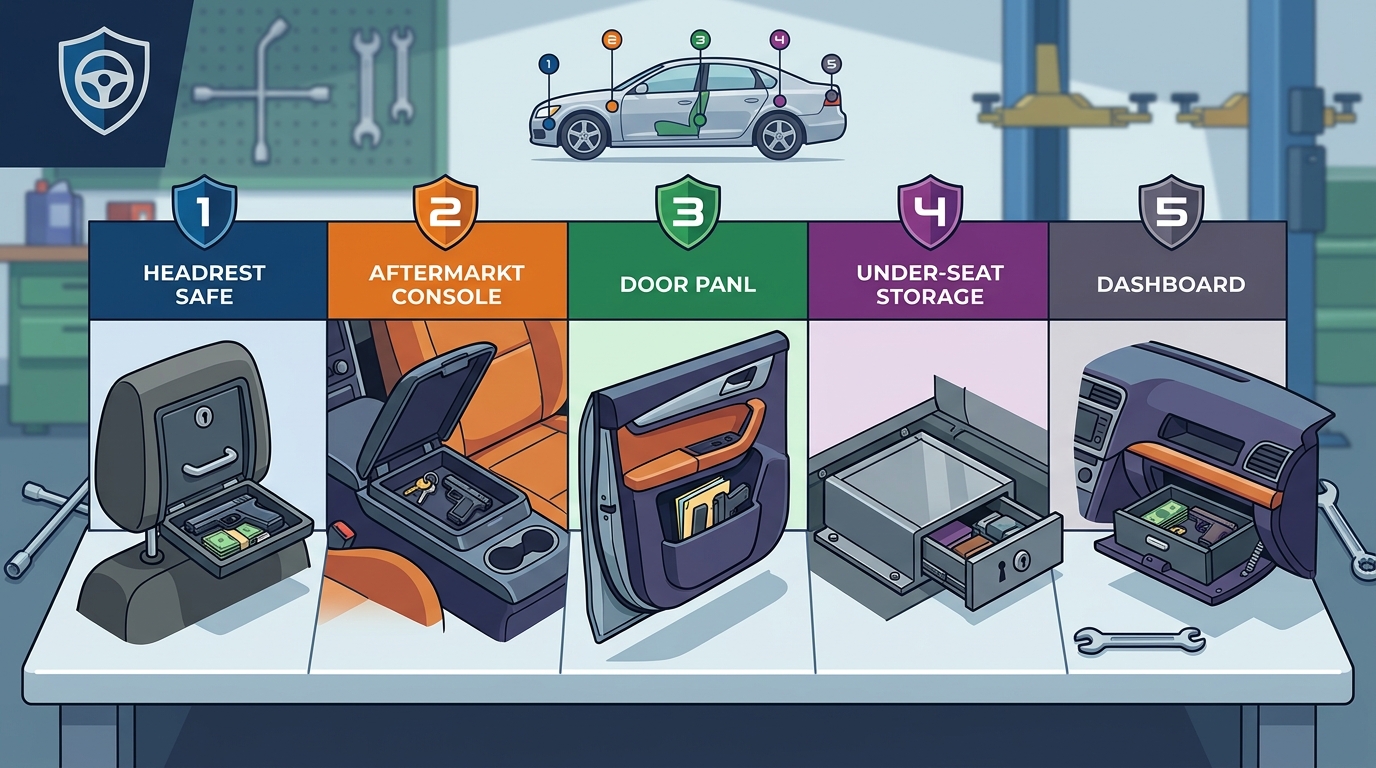
Yes — discreet car gun safes absolutely exist, and the market in 2026 offers far more variety than most drivers realize. From safes hidden inside your headrest to models that disappear into factory center consoles, the options span five distinct concealment categories. This guide breaks down each category so you can match the right discreet safe to your vehicle, lifestyle, and legal obligations.
Why Discreet Storage Matters More Than Ever
The urgency behind concealed vehicle firearm storage is backed by hard data. According to research analyzing FBI crime data from 337 cities, at least one gun is stolen from a car every nine minutes in the United States. Even more alarming, by 2022, 40% of all reported gun thefts involved a vehicle — up from 31% in 2018.
Gun thefts from vehicles increased by 225% over the past decade, even as overall vehicle thefts declined. States with weaker gun safety laws see up to 18 times the rate of gun thefts from vehicles compared to states with stronger legislation. Colorado and Delaware have already passed laws requiring firearms stored in vehicles to be locked in secure containers, and more states are considering similar mandates.
The takeaway is clear: leaving a firearm unsecured — or even in a visible lockbox — creates risk. Truly discreet solutions hide the safe itself, removing any visual cue that a firearm is present.
Category 1: Headrest-Integrated Safes
Headrest safes represent the most innovative approach to vehicle firearm concealment. Products like The Headrest Safe replace your existing headrest with a unit that contains a hidden locking compartment inside. From the outside, it looks like a standard automotive headrest — no visible locks, seams, or hardware that would signal storage to a thief or passenger.
Why This Category Stands Out
- True invisibility: Unlike under-seat or console options, a headrest safe doesn't occupy any visible or searchable space in the cabin.
- Driver-accessible: The safe sits directly behind the driver or front passenger, keeping the firearm within arm's reach without requiring you to lean, bend, or reach under a seat.
- Universal fit potential: Headrest safes are designed to work across a wide range of vehicle makes and models using standard headrest post dimensions.
- Multi-use storage: Beyond firearms, these safes can secure cash, medication, passports, and other small valuables.
This category is ideal for drivers who want zero visual footprint — thieves who break into a vehicle would have no reason to inspect or remove a headrest.
Category 2: Factory Console-Integrated Safes
Console-integrated safes fit inside your vehicle's existing center console compartment, essentially turning factory storage into a lockbox. Console Vault is a well-known brand in this space, offering vehicle-specific models for popular trucks and SUVs. They have secured an official Ford licensing partnership and produce safes designed for specific models like the F-150, RAM 1500, and Jeep Wrangler.
Pros and Limitations
- OEM-level fit: Because each safe is molded for a specific vehicle, it integrates seamlessly with the console lid and interior.
- Multiple lock types: Options typically include barrel key locks, electronic keypads, and combination mechanisms.
- Vehicle-specific limitation: You must purchase a safe matched exactly to your make, model, and year. Switching vehicles means buying a new safe.
- Visible compartment: While the safe itself is hidden beneath the console lid, the center console is a known search point for thieves.
Category 3: Under-Seat Portable Safes
Portable safes designed to slide under a vehicle seat represent one of the most popular categories. Brands like Vaultek (LifePod 2.0) and GunVault (MV500 Microvault) fall into this group. These safes are typically tethered to the seat frame with a steel security cable and offer biometric, keypad, or RFID access.
Key Features to Evaluate
- Biometric speed: Modern fingerprint scanners on models like the ONNAIS Biometric Pistol Safe can unlock in under one second and store 80+ fingerprint profiles.
- Portability: These safes double as travel lockboxes — you can remove them from the vehicle and carry them in a bag or store them in a hotel room.
- Silent mode: Many models include a silent operating mode for discreet access without audible beeps.
- Space constraints: Adjustable power seats in modern vehicles leave minimal clearance under the seat, which can make placement difficult in some cars.
The trade-off with under-seat safes is discoverability. A determined thief who reaches under the seat will find and potentially remove the safe — even with a cable tether.
Category 4: Trunk and Cargo Area Vaults
For truck and SUV owners, full cargo-area vault systems from manufacturers like TruckVault provide heavy-duty concealment in the bed or trunk area. These are large, bolted-in drawer systems that hide firearms beneath a flat surface, often doubling as a gear platform.
Best For
- Law enforcement, security professionals, and outdoor enthusiasts who carry long guns or multiple firearms.
- Vehicles with dedicated cargo space (pickup trucks, large SUVs, expedition rigs).
Considerations
- Installation is more involved — these are semi-permanent fixtures.
- Access requires walking to the rear of the vehicle, which is slower than cabin-mounted options.
- Higher price point compared to portable or console safes.
Category 5: Mounted Lockbox Safes
This category includes steel lockboxes that mount to specific points inside the vehicle — under the dashboard, on the transmission tunnel, or bolted to the floor. They use pre-drilled mounting holes, heavy-gauge steel, and pry-resistant designs. The GunVault NanoVault and similar compact boxes are common here.
What to Look For
- Steel gauge: For meaningful pry resistance, look for 14-gauge steel or thicker. Standard gun cabinets use thinner 16–18 gauge steel, which offers less protection.
- Anti-pry tabs: Concealed hinges and reinforced U-locks make forced entry significantly harder.
- Backup access: Always choose a model with both electronic and mechanical (key) entry in case batteries fail.
The drawback is visibility. A mounted lockbox is physically present in the cabin — anyone who enters the vehicle can see it. This makes it the least discreet option, though it offers strong physical security when properly installed.
How to Choose the Right Discreet Category for You
| Category | Concealment Level | Access Speed | Vehicle Compatibility | Price Range |
|---|---|---|---|---|
| Headrest Safe | Highest | Fast (arm's reach) | Universal | $$ |
| Console-Integrated | High | Fast | Vehicle-specific | $$–$$$ |
| Under-Seat Portable | Moderate | Moderate | Most vehicles | $–$$ |
| Trunk/Cargo Vault | High | Slow | Trucks/SUVs | $$$–$$$$ |
| Mounted Lockbox | Low | Fast | Most vehicles | $ |
Legal Considerations for Vehicle Firearm Storage
Before purchasing any vehicle gun safe, research your state and local laws. Some states now require firearms stored in vehicles to be locked in a secure container. Colorado and Delaware have enacted such legislation, and additional states are actively considering similar mandates. Currently, only 16 states and the District of Columbia require gun owners to report lost or stolen firearms to law enforcement.
A discreet safe does more than deter theft — it demonstrates responsible ownership and can help you stay compliant with evolving transportation and storage laws.
Key Takeaways
- Discreet car gun safes exist across five distinct categories, each with different concealment levels, access speeds, and price points.
- Headrest safes offer the highest concealment because they are completely invisible inside normal vehicle components.
- Gun thefts from vehicles have surged — 40% of all gun thefts now involve vehicles — making concealed storage a practical necessity.
- States are increasingly passing laws requiring locked containers for firearms in vehicles.
- Always choose a safe with multiple access methods (biometric, keypad, key) to ensure you can always retrieve your firearm.
Frequently Asked Questions
What is the most discreet gun safe for a car?
Headrest-integrated safes, like The Headrest Safe, offer the highest level of concealment because they replace a standard vehicle headrest with a unit containing a hidden compartment. There are no visible locks, cables, or boxes for a thief to spot.
Are car gun safes required by law?
In some states, yes. Colorado and Delaware have passed laws requiring firearms left in vehicles to be stored in locked containers. Other states are considering similar legislation. Check your local regulations before transporting a firearm in your vehicle.
Can a thief easily remove an under-seat gun safe?
Under-seat safes secured with a steel cable provide a deterrent, but a determined thief with tools can cut the cable. Safes that are completely hidden — such as headrest or console-integrated models — reduce the risk because the thief never identifies the safe in the first place.
How fast can I access a biometric car gun safe?
Modern biometric car gun safes can unlock in under one second using fingerprint recognition. Many models also support keypad codes, RFID, and physical keys as backup methods.
Do discreet car gun safes fit all vehicles?
It depends on the category. Headrest safes and portable under-seat safes are designed for broad compatibility. Console-integrated safes are vehicle-specific and must match your exact make, model, and year.